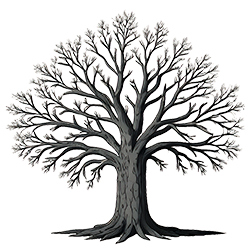
Next year, the United States of America will celebrate 250 years of existence. A noteworthy milestone that will prompt much reflection on the trials, successes, and opportunities envisioned by our country’s founders. Based on its estimated age, the Sterling Oak was likely here at that time, which is quite remarkable to think about. By the time President Lincoln was assassinated, this oak tree in our yet-to-be-formed suburb of Sterling Heights, Michigan, was likely past 100 years old and yet still considered young for an oak.
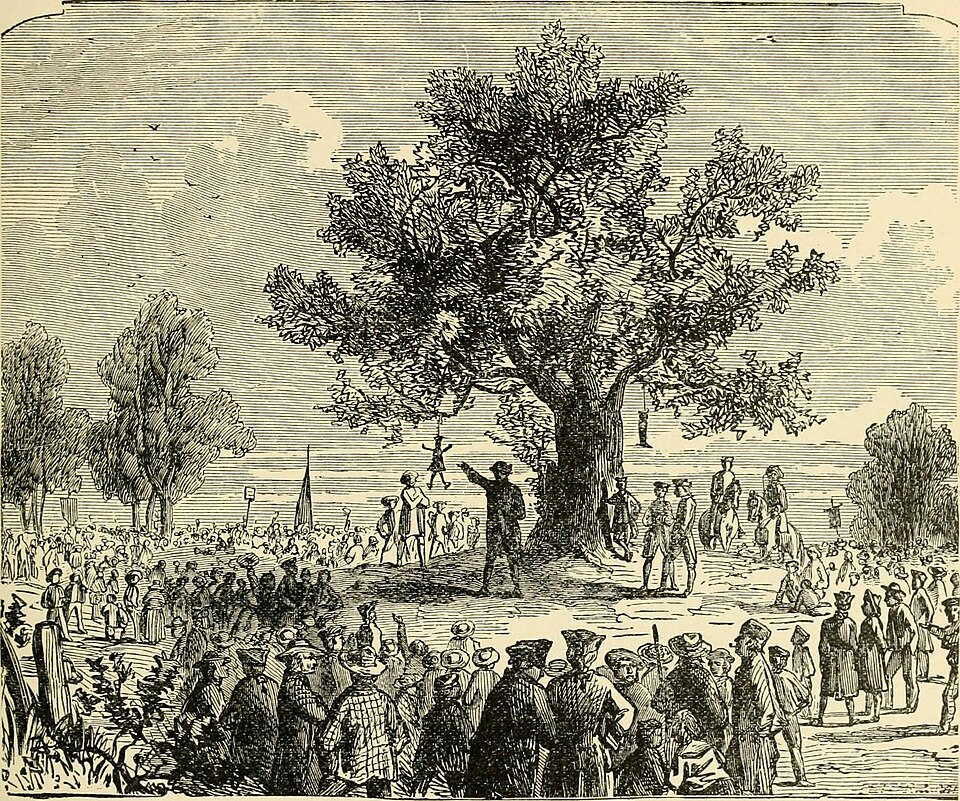
A tree in Boston, named The Liberty Tree, became a rallying symbol of the revolutionaries in the British colonies, the very Sons of Liberty who created the rallying cry of “No taxation without representation.” A phrase etched into the minds of even the poorest students of American history.
The Liberty Tree is depicted above from the 1865 edition of Cassell’s Illustrated History of England. It became a well-known symbol and a location for political meetings and protests. The Sons of Liberty mark their foundational moment when an effigy of a Stamp Act loyalist hung from the tree and ordered to be taken down, the sheriff was blocked by an angry mob.1 Paul Revere included it as a symbol in an engraved political cartoon in 1765.2 Thomas Jefferson made reference to the tree in his letters.3
The tree was recorded as being cut down by British troops and loyalists to strike back at this powerful symbol of the revolutionaries.

These instruments of nature do not need a website, a journal, or even a feather dipped in ink. Many trees have become powerful symbols throughout history; others simply passively record changes in the environment around them. They are perhaps the ultimate unbiased record keepers of history. They simply need to be left alone to serve as witnesses.
A book reviewer for the New York Times once pointed this out for the book, The Witness Tree by Lynda V. Mapes; “The intriguing, and more intimate, Witness Tree . . . portrays trees as ‘scribes, diarists, historians’ They are ‘among our oldest journalists.’ A reporter herself . . .” about her chronicling of her experiences with a single oak tree.
Other authors have remarked similarly, like Robert MacFarlane, perhaps the most well-known author of our time focusing on nature literacy, in his book “The Old Ways: A Journey on Foot”;
“Single trees are extraordinary; trees in number more extraordinary still. To walk in a wood is to find fault with Socrates’s declaration that ‘Trees and open country cannot teach me anything, whereas men in town do.’ Time is kept and curated and in different ways by trees, and so it is experienced in different ways when one is among them. This discretion of trees, and their patience, are both affecting. It is beyond our capacity to comprehend that the American hardwood forest waited seventy million years for people to come and live in it, though the effort of comprehension is itself worthwhile. It is valuable and disturbing to know that grand oak trees can take three hundred years to grow, three hundred years to live and three hundred years to die. Such knowledge, seriously considered, changes the grain of the mind.
Thought, like memory, inhabits external things as much as the inner regions of the human brain. When the physical correspondents of thought disappear, then thought, or its possibility, is also lost. When woods and trees are destroyed — incidentally, deliberately — imagination and memory go with them. W.H. Auden knew this. ‘A culture,’ he wrote warningly in 1953, ‘is no better than its woods.’ ”
― Robert Macfarlane, The Old Ways: A Journey on Foot
Unfortunately, not everyone thinks about trees this way, nor does everyone care about the history they hold. Not every tree is destined to become such a powerful symbol in the birth of a nation. Is it unrealistic to expect to change the grain of the minds of the individuals who have the power of a vote? Can we step away from our hubris with enough distance to see how our policies, ordinances, and ways of thinking have failed to value such historical scribes?
Despite all the surveys, reviews, consultants, studies, and ‘greening’ campaigns, this area’s “oldest journalist” failed to receive any notable recognition other than rationalizations of replacement. The records within, that continue to be recorded, and yet to be are never known or valued. Our centuries-long quest for a more perfect Union and to better understand the impacts on the environment around us is difficult if we continue to erase and pave over the past.
Near the end of the December 16 Sterling Heights City Council meeting, Councilwoman Barbara Ziarko brought up the looming 250-year milestone of the United States and how the City of Sterling Heights should consider ways to recognize and honor it. What better way to honor our history, pay tribute to the powerful symbol of the original colony’s revolutionaries, advance a vision of a sustainable future, and learn from mistakes than to advocate for the preservation of what may well be our oldest journalist?
Please write and call the Sterling Heights City Council to let them know this is important to you – our past, future, and everything in between. They still have the power to change course. That is a true commitment to preservation and to honoring our history. You will find their contact information linked below:
- The Story Behind a Forgotten Symbol of the American Revolution: The Liberty Tree, Smithsonian Magazine, 2016 ↩︎
- Massachusetts Historical Society, A View of the Year 1765 ↩︎
- Thomas Jefferson letter to William S. Smith, 1787 ↩︎
Leave a Reply