
When this site started, the simple premise was to provide additional information for context and understanding beyond what the initial reporting on the threat to this old tree could offer. People wanted more information, and for many, seeing it in a local paper was the first time they learned the City had a tree older than this country on protectable city property. City responses to the media left people asking more questions.
The spin became heavier, sadly, leading to attempts to sabotage the certification and ultimately promoting falsehoods about preservation, even including ad hominem attacks on the advocates. If you care about this majestic tree, great; if you care but think that housing is more important, that’s fine too. At least acknowledge that it never had to be a choice of one or the other. If that is confusing to you, then you are a victim of how information on this development was spun and presented. If you don’t care about the tree at all, well, you probably aren’t reading this post… but you might still be interested in how controlled information shapes opinions, regardless of the topic.
Dilemmas and Decisions
While this post is not attempting to open wounds, it is necessary to go down a bit of a psychology rabbit hole if we want to make an effort to understand how the decision to create the threat to this majestic oak is more troublesome than simply choosing “a tree vs. housing.” The selective presentation of information (which this post will provide examples of), along with omissions and/or obfuscation, whether intentional or unintentional, creates problems in decision-making that theoretically should be as unbiased as possible.
Sterling Heights Council election 2025
A city council election occurs in just a few weeks. The Sterling Oak certainly isn’t expected to be a central issue of this election; it may or may not be key in your own mind in selecting who genuinely represents what you care about. If you think the Sterling Oak advocates care only about a single tree, you haven’t been listening.
This old, majestic tree has simply become a lead role in this particular disaster movie with a whole ensemble cast and storyline about floodplain development, placing vulnerable people there, land ethic, preservation, bait and switch tactics, and the ways information can be presented to shape opinions. Who knew a tree could represent so much, eh?
More broadly, critical thinking, analysis, and ethical land practices should be key election issues, especially in a time when green space is in critical need. Policies, procedures, and communication tactics will influence many decisions regarding the preservation of green space and natural assets for years to come. We should expect such decisions to be presented fully and plainly, not surrounded by confusing weasel words and polished public relations statements.
The City of Sterling Heights simply doesn’t have much green space left to play games with. It demands extra attention and care if we want to change the course of past practices and be more responsible stewards of these spaces for future generations to enjoy and benefit from.
As City Manager Mark Vanderpool reflected on taking the declining green space for granted in 2023, it became clear how decisions and past practices have led to Sterling Heights having one of the lowest tree canopies in the area. It isn’t all due to the emerald ash borer. Decision-making mistakes, weak protection policies, and sacrifices of natural habitats have long-term consequences that cannot be undone. Environmental history is littered with thousands of examples and remorseful statements of “we didn’t know…” after it is too late. We have no such excuses with this parcel of land.
“When we had vast amounts of green space, it was ok if we didn’t always hit it perfectly… But we don’t have that, now being fully built out.”
~ Sterling Heights City Manager Mark Vanderpool to C&G Newspapers, June 5, 2023

Words matter, and the fine art of baloney detection
Before getting into specifics related to this particular development and the tree, let’s baseline a few key terms any citizen should be aware of:
Misinformation is false information shared without the intent to deceive, arises from misunderstandings or errors.
Disinformation is false information spread deliberately to mislead and/or persuade others as in propaganda or false narratives.
False Dilemma: presenting a scenario that erroneously limits what options are available to influence a decision
Framing Effect Bias (related Observational selection): a cognitive bias where people’s decisions change depending on how options are framed, with observational selection known as “counting the hits and forgetting the misses (e.g., A state boasts of the Presidents it has produced, but is silent on its serial killers).”1
Each of these can have a strong influence on how we process information and make decisions. The framing effect has consistently been demonstrated as one of the most significant biases in decision-making. We see exploitive manipulation of it every day, from social media to politics to used-car sales (look at the new tires on this beauty!).
In 1996, Carl Sagan wrote an entire chapter on “The Fine Art of Baloney Detection,” highlighting the tricks of the trade used to confuse or convince us, taking advantage of the fact that our brains, interestingly, do not want to work too hard to tell truth from spin. Our only defenses are to be aware of this susceptibility, recognize their uses, and use them to strengthen our reasoning.
We tend to fill in knowledge gaps with trust in relationships, familiarity with presenters, our own experiences and backgrounds, morals, motives, ideologies, or through research. Any one of these may also influence how much probing an individual does to determine if these strategies are in use. Remember, our brains naturally don’t want to put in so much work.
“True sustainability cannot thrive in the shadow of greenwashing and tokenism. When impact is sacrificed for optics, and promises are made without purpose, we betray not only the environment but also the trust of those we claim to serve. Real change demands accountability, transparency, and a commitment to actions that speak louder than crafted narratives.” ~ P.Sinha, 2024
Our only motivation – to protect nature
While it is natural to act a bit defensively when people are critical of your decisions, it’s also important not to make it worse by responding with dismissal or other fallacies. There was (is) a lot of “noise” surrounding this particular development in the city, or even the notion of apartments. Some residents have made poorly backed or unjustified comments, and some have used suspicious tones of racism and xenophobia, which don’t help protect this tree and habitat whatsoever. If anything, it may hinder the efforts by amplifying defensive reactions. If those are your true motivations, you are not helping this cause.
The original motivations for protecting this tree are based on appeals to safeguard—truly protect—declining natural assets and habitats where we live. These motivations should be taken seriously and not muddied by confusing, conflicting, or vague reasoning; they are wholly unrelated to the type of housing. It’s a problem if all the protests against this development are lumped together by the presenters and beneficiaries as a bunch of NIMBYs, a label framed this way immediately after the passing vote.2
With that, let’s take a look at how information was presented related to the threats to this tree and habitat.
Some examples
The ability to reason and understand, on behalf of residents and representatives, involves the transparency and accessibility of information. Not many people watch city council meetings. It’s an arduous task, many of them quite long. Some are quite informative, others not so much. After a long day, who can spend 2-5 hours watching a meeting or sorting through 400 pages of an agenda packet? If people do watch, it is likely that many just rely on summarized presentations. In a city of 135,000 people, 100,000 registered voters, the most replay views of a city council meeting on YouTube is a meager 515.
People don’t know what they don’t know. If you don’t know or understand, or if you rely too much on trust without verifying, you can’t ask the right questions. As such, these are a few examples that could have benefited from more thorough due diligence by our elected officials and presenters. Good people can still make mistakes. The segments were chosen simply to relate to the corresponding point and let the people’s words speak for themselves, not due to any intentional observational selection or cherry-picking. 😊
Example 1: Pathways to Play and Preservation Millage FAQ

A Little More Context
Note the language in the FAQ on the city website prior to the PPP millage about dangers if it fails.
Also, on purchase of the Riverland Property in 2022 with ARPA funds:
- Councilwoman Barb Ziarko: ““If we don’t own it, we can’t control it.”
- Councilman Mike Radtke: ““make a public park there as a part of the future of North Van Dyke … a bunch of empty land … this park is gunna be a jewel on the river …”
Baloney Detector: 🟡 (future uncertain)
Framing Effect: The FAQ provided prior to the millage (now gone from the city website) used a particular framing effect to warn of the consequences if it didn’t pass. The message: we will never get any better if this doesn’t pass.
The Pathways to Play and Preservation millage in Sterling Heights, which passed in November 2024 and included a component of land preservation, was a noted reason why two city councilwomen (Koski and Schmidt) voted against the development of the city-owned Riverland green space. Interestingly, Mayor Pro Tem Sierawski’s remarks of the 7/16/24 meeting expressed concerns of integrity, honesty, and the contradiction to the millage aspect of land preservation.3 But, she flip-flopped her vote in August, voting in favor of the development, claiming she talked to some people and the development “wouldn’t hurt the land.”
The contradictions and concerns with integrity didn’t disappear in a month.
“… we will be spending millions of dollars to acquire property and preserve it as open space in areas that are not development areas.”
– City manager vanderpool, july 1, 2025
Eight months after the millage passed, at a July 1, 2025, City Council Meeting, City Manager Mark Vanderpool added an interesting qualifier on the use of PPP land preservation funds: they would not be used in “development areas.”4 A curious disclaimer, not mentioned to voters previously, is a significant limitation. The city website expressly stated that the intention is to protect property from private development and the loss of green space. “Development area” can apply to anywhere in the city, and where else would private developers develop?
Planting 15,000 trees
Aside from land preservation, in facing questions about the centuries-old oak, officials have consistently pivoted on the tree planting aspect of the above millage. Sterling Heights has a low tree canopy of 19-22% or so, depending on which study you look at. We must also be conscious of how the framing of what exactly 15,000 trees will do for the city is presented.
The figure of 15,000 trees originates from the Jan 2024 Strategic Planning session presentation, which proposed planting 15,000 trees over 5 years. The context of what 15,000 trees achieve in terms of the canopy was fleshed out by none other than Mayor Michael Taylor during that meeting.
One Percent Canopy Growth: To Mayor Michael Taylor’s credit, his detailed questions provided more context for what 15,000 trees contribute to achieving a 40% canopy goal. The 15,000 trees planned to improve the canopy will only increase the city’s canopy by an estimated 1%, according to the referenced tool.
If they all survive (they won’t, and losses beyond 1 year are not covered by warranty), they will not change the city’s canopy position very much. As Mayor Taylor also stated, it is one of the things about the city “he is least proud of.” The video segment below is queued to this portion of the meeting and is worth watching.
This doesn’t mean planting more trees isn’t a good thing or desperately needed beyond grant funding; it is just important to understand context and scale. From the aspect of walking the talk, it is a 1% step forward. We just need to be wary of spin-doctored statements that state we are “reforesting the city,” as the investment needed to reach 40% is well beyond the $9 million included in the millage.
It also emphasizes the increased attention and valuation needed for existing canopy, particularly old-growth trees, which act as support systems in forested areas.5 The 1% is further diminished by trees lost to more development, and planting new trees is expensive.
Example 2: “Minimal Disruption”
“… a vast majority of the property almost 7 acres will be preserved for open space and park space and a river walk that will connect Van Dyke to Riverland … this particular development will be on the frontage of the road so approximately 2 acres … doing nothing in these areas and letting them continue to decline is not an answer when the Riverland Amusement park was there generated property taxes it declined it eventually closed and the property taxes and property value declined obviously that area declined this plan is invigorating new life into the area …
– Sterling Heights City Manager Mark Vanderpool, responding to a resident’s concerns about the property floodplain development, July 2, 2024 before any votes have taken place
Baloney Detector: 🔴
Framing Effect / Misinformation (Disinformation?): In this case, you hear the reference to 7 acres preserved and 2 acres for the development. This is a good example of a positive framing effect. One could reasonably come away with the reaction of “well, that doesn’t sound too bad. Most of it is preserved, and we can do a good deed of providing affordable housing …”, right?
But what is the reality?
The land deal arranged between the city and CCF involves a complete transfer of approximately 10 acres. After the building is done, approximately 8 acres will be transferred back to city ownership. It is false that 8 acres (or [sic] 7 acres) will be preserved.
Approximately half of the land returned will be clear-cut, with the soil compacted and a large hole created by the cut & fill floodplain development operations, with zero canopy remaining. The remaining half closest to the river is already protected by the state as part of a regulated floodway – nobody can build on it. All of this was available information at the time the statement was made.
So why frame it that way if it isn’t true?
This framing results from either misinformation or disinformation about the full impacts of the development. To be generously fair and provide the benefit of the doubt, it’s possible the City Manager simply didn’t understand the full scope and details of the destruction to take place. At worst, it implies intentional deception or manipulation of the positive framing to minimize the resident’s concerns about building here.
The benefit of the doubt erodes when the same framing continues to be used in media responses nearly 9 months later, after extensive reviews have been conducted.
“This development includes 10.5 acres, of which eight acres will be preserved as open space. The two acres being developed will be along the roadway, which is mostly void of trees.” – City of Sterling Heights to WXYZ, April 14, 2025
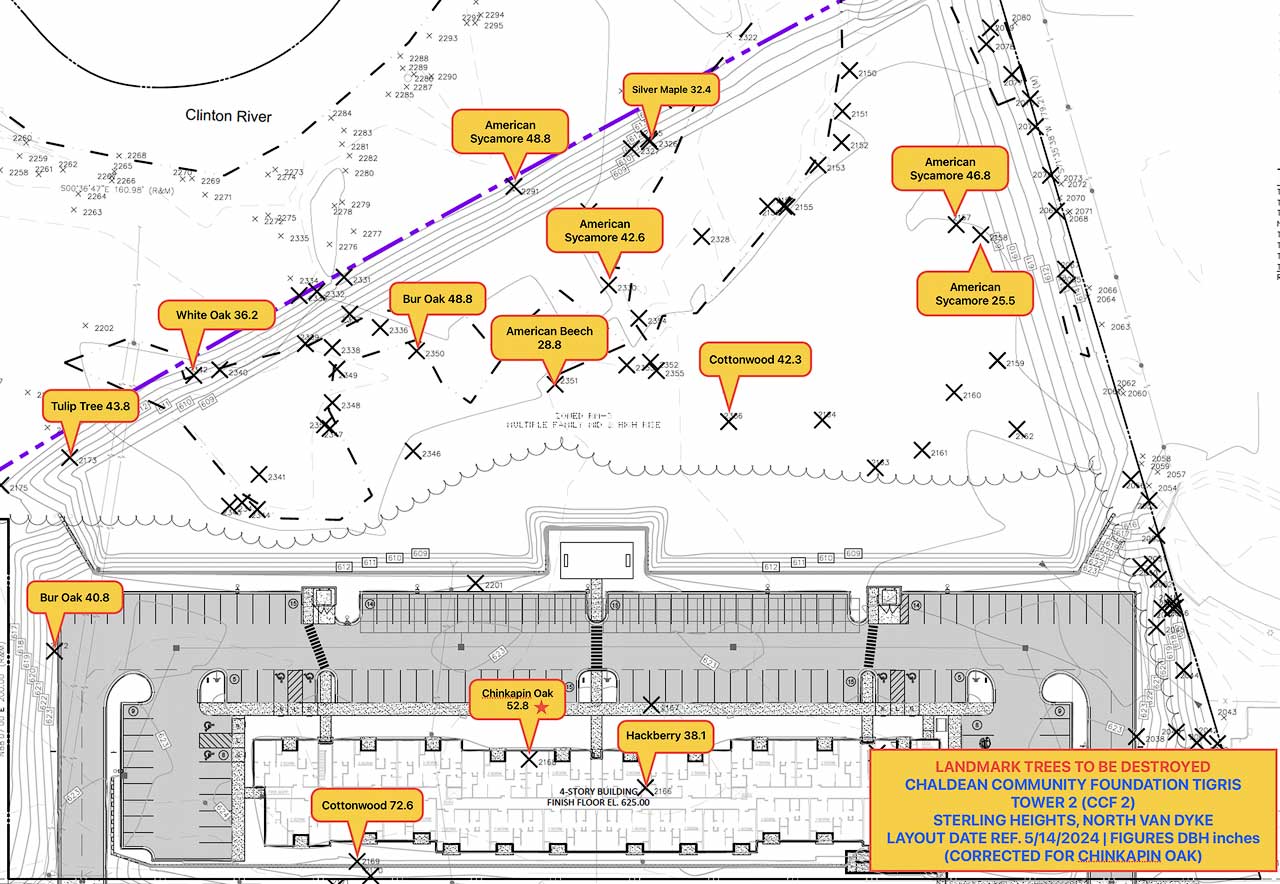
Note the positive framing messages: minimal impacts, “mostly void of trees” in response to resident concerns. Reality: 14 landmark trees would be destroyed and 6 known wetlands, smaller trees, and any other associated environmental disruption by the cut & fill operations; soil compaction, stormwater absorption, etc.
Example 3: “Doing a good job preserving trees”
Aspects of the impact on trees weren’t completely ignored in the sale of the Riverland property. In this last example, concerns about the old oak are brought up in a discussion between Councilman Michael Radtke and City Planner & Development Manager Dr. Jake Parcel before the final vote in August 2024.
“The applicant is doing a really fantastic job with tree preservation preserving 69% of the trees on site…” – Dr. Jake Parcel, City Planning and Development Manager
Baloney Detector: 🔴
Framing Effect: This sounds pretty good, right? On the surface, someone could think .. cool, 69% preserved. (ignoring type, age, and size of trees) Look deeper: The 69% is what the applicant included on their tree survey summary. This is a reference to all the trees that are ALREADY PROTECTED from development by the State of Michigan in the floodway. The number of trees and canopy preserved in the allowable area outside the floodway: ZERO.
There is discussion about how landmark trees have inch-for-inch replacement requirements, and an unsubstantiated remark about Sterling Heights having one of the strongest ordinances in the state (Note: This is debatable! It is true that the ordinance was somewhat strengthened just a few years ago after decades of abuse, but no known evidence supports the claim that it is the strongest. Key point – many cities have specific canopy protections, but Sterling Heights does not. Should such evidence surface, it will be added and corrected here.)
Then the conversation shifts to focusing primarily on the number of trees, regardless of their size, age, or environmental benefits. To provide the benefit of the doubt as a misinformation error, Dr. Parcell mentions that tree surveys are not reviewed in any depth until near the end of the entire process. This should be noted as a problematic process if environmental protection is to be prioritized.
Instead of examining the location of the “preserved trees” on the layouts, he framed the issue quite positively toward the applicant based on a limited review. The fact that those trees are in an untouchable area is an important detail. Current ordinances don’t clearly distinguish between trees already in protected zones, allowing a developer to claim credit for “preservation,” which is disingenuous.
Dr. Parcell deserves a pass if his remarks resulted from not reviewing the tree survey carefully enough, but not if they are intended to add to the overall persuasion pushing for approval. Such framing is similar to companies selling carbon offset credits for preserving trees for forests in a national park that are never going to be cut down anyway – one of the larger greenwashing concerns of recent years.
As explained previously, because of the design of the land swap deal arrangement between the City of Sterling Heights and the CCF, the net result is that the developer earns credit towards trees they don’t have to replace, a “fantastic job” compliment, and the framing-biased, misleading impression any willful act of the developer is preserving 69% of trees in front of decision-makers. Baloney detector alarms are ringing strongly here.
We can do better
Specific framing and word use can create misleading perceptions and illusions, intentionally or unintentionally. Consider the understandable basic empathy for affordable housing sponsored by a city organization for people fleeing a war-torn country and facing religious persecution. Saying no to development on this parcel doesn’t mean such endeavors or organizations aren’t important, but it’s disingenuous to present it as a false dilemma – the NEED to pick one OR the other. Creative examples exist of building apartments and housing in developed areas without further environmental degradation.
It’s possible that knowing these additional details wouldn’t have changed the outcome of the August 2024 vote. Maybe it would have? The City Manager stated plainly on July 2, 2024, about the interest in recovering lost property taxes from the time when the amusement park was there. One simply can’t talk one moment about the benefits of trees and green spaces and at the same time frame the very same spaces as being in “decline” and “doing nothing” because you have another objective in mind.
The Mayor, despite the 2024 expression of remorse about the city’s tree canopy, and others may still have chosen the housing, even though no evidence was presented that other potential locations were ruled out. In his more recent commentary at a July 15, 2025, City Council meeting, he acknowledged and was sensitive to advocates for the Sterling Oak, but framed it as the false choice mentioned above: “housing for 80 people vs. a tree,” and generalizing how “trees were removed so you can live there.”
Given the theme of this post, think about the framing the Mayor used to make his point. On many other issues, he uses quite sound and understandable reasoning, but here? At face value, the city leader implies a certain selfishness and/or hypocrisy: don’t cut down that tree, but ignore the ones cut down where I live. It is a persuasive, but hyperbolic argument.
The vast majority of Sterling Heights was already farmland cleared of trees; he was using hyperbole to make his point. He really didn’t know if people had trees cleared to build their house or not.

He also attempted to reframe the argument, as attorneys expertly do, away from the aspect that this is city-owned, protectable green space. (Sterling Heights is still listed as the parcel owner) If this is ultimately the logic with city-owned property, would it not be selfish to prevent the sale of more city-owned land for more housing? If yes, let’s just say it plainly and reset resident expectations.
This is the rare green space identified in the North Van Dyke Avenue Master Plan, offering nature-based, economical solutions worthy of preservation for flooding mitigation and more noted throughout other city plans. The exact type of valuable tract of land the city claimed as a goal to save from private development interests, and persuaded voters to approve a tax increase to do so. Why obscure the intentions for housing in advertising the land purchase for park improvements?
Lessons learned mean we acknowledge past mistakes, as Mr. Vanderpool did on green spaces, and make the appropriate policy changes moving forward to avoid them. The city has done this with some words, programs, and some token actions. Situations like this Riverland Park parcel begin to establish proof of real commitment to walk the talk in the face of other potential uses.
Trees, with millions of years of evolution behind them, are living contributors to the environment – for centuries if they are lucky enough to be far enough away from development interests. We are still learning about their critically important connections to ecosystems, how they communicate with one another, and how they support other species as their neighbors. As Mayor Taylor stated, “you feel better to be around them” – and there is actually science to back that. Our past actions, ignorantly sacrificing so much, have created environmental deficits everywhere, even in spaces theoretically protected.
The Purchasing Agreement for this development has a provision to opt out with no penalties for either party by Jan 1, 2026.

All of the evidence points to this decision being a mistake, influenced by persuasive and misleading messaging that even changed a councilmember’s vote. The current council can do this, or a reconfigured one can. Consider this an appeal to reason.
Once the trees and wetlands are gone, they are gone. Nobody can use the remorseful “we didn’t know” in this case.
We absolutely know.
- Jessica Stillman, “The 9 Simple Principles in Physicist Carl Sagan’s Baloney Detection Kit will Make You BS-Proof,” Inc. Magazine, Jan 2024 ↩︎
- Comments from Contractor, Project Leaders, and proponents after the vote by the Sterling Heights City Council, Aug 2024 ↩︎
- Liz Sierawski remarks in process, City Council Meeting, July 16, 2024, queued to 1:49:29 ↩︎
- City Council Meeting, July 1, 2025, queued to 1:49:28 ↩︎
- Morgan Sherburne, “Old-growth trees more drought-tolerant than young ones, providing a buffer against climate change“, University of Michigan, 2022 ↩︎
Leave a Reply